Past ghosts and old posts.
Future Lives
Chapter 155: Future Lives
It’s now months after the incidents, and even a few months after my wedding and honeymoon. Things are slowly going back to normal. I’d be lying if I said I don’t occasionally think about what was lost in the scam, or where I could be financially right now, but the sting is less severe. Moving on is hard, but on some days, I can almost forget everything that happened—and I think that’s a good sign.
Once in a while, I read or hear something that brings me back to those memories, but rarely does it trigger a large reaction anymore. More often, those moments bring insight rather than pain—they help me gain closure. Recently, one idea that stuck with me is the concept of a “threshold of happiness.” It’s the notion that everyone has a limit to how much happiness they can comfortably experience—beyond a certain point, it becomes unfamiliar, even anxiety-inducing. It sounds strange, but I think most people can relate. When things are going well, we instinctively wait for the other shoe to drop. Maybe that’s what anxiety really is: an inability to accept peace without expecting disaster.
This concept resonated with me because I’m still trying to understand why my mom would throw away everything she had. Maybe we had finally reached a level of happiness and stability that she wasn’t equipped to handle. Maybe she had simply reached her threshold. Following that thought led me down a rabbit hole of all the ways her upbringing might have left her unequipped to live securely.
My mom was born just after the famine years in China. Her childhood was marked by instability and scarcity—of food, of safety, of opportunity. My grandmother wasn’t the best parent, and my grandfather died young from cancer. It’s no wonder that she grew up never really knowing what “security” felt like.
Would that affect her relationship with my dad? It’s hard to say. But I know that I have been influenced by both my parents—their presence and their absence—and I’m not ashamed to admit that both shaped me, for better and for worse. It’s easy to trace the lines between parents and children; it’s practically written in our DNA.
However her relationship with my dad went, it ended badly. Whether that was because of her past or his, I’ll never know. But that left me with a mother who had never experienced true stability and who also carried the weight of romantic and emotional failure. That’s not an easy hand to be dealt.
One of the more painful lessons I’ve learned is that sometimes what doesn’t kill you doesn’t make you stronger—it just changes you. Sometimes it makes you cynical (raises hand), and sometimes it leaves scars that never really fade. For my mom, I think that’s what happened. She was scarred, and she didn’t hold back those scars when raising me.
From that perspective, it’s hard not to see her as human—all too human. She never knew security, so she couldn’t pass it down. When her career finally became stable, I think it scared her. When I tried to build a more positive relationship with her, that too might have been unfamiliar. Maybe she just didn’t know how to exist in peace. Too much happiness can feel foreign to someone used to surviving chaos.
Does this interpretation paint my mom as damaged? Yes. Does it make me feel a kind of pity for her—perhaps a bit condescendingly? Also yes. But pity is easier to live with than anger. Feeling sorry for her feels lighter than resenting her. I don’t pretend to have come up with this all on my own; I’ve talked about it with my wife and friends. They tell me it’s a step in the right direction—because it at least means I’ve accepted the past. And that’s something. Not a resolution, not a solution, but a sign that things are moving forward again. I’m healing, and my wife and I are still moving on. The old scars still resurface sometimes, but they’re manageable now.
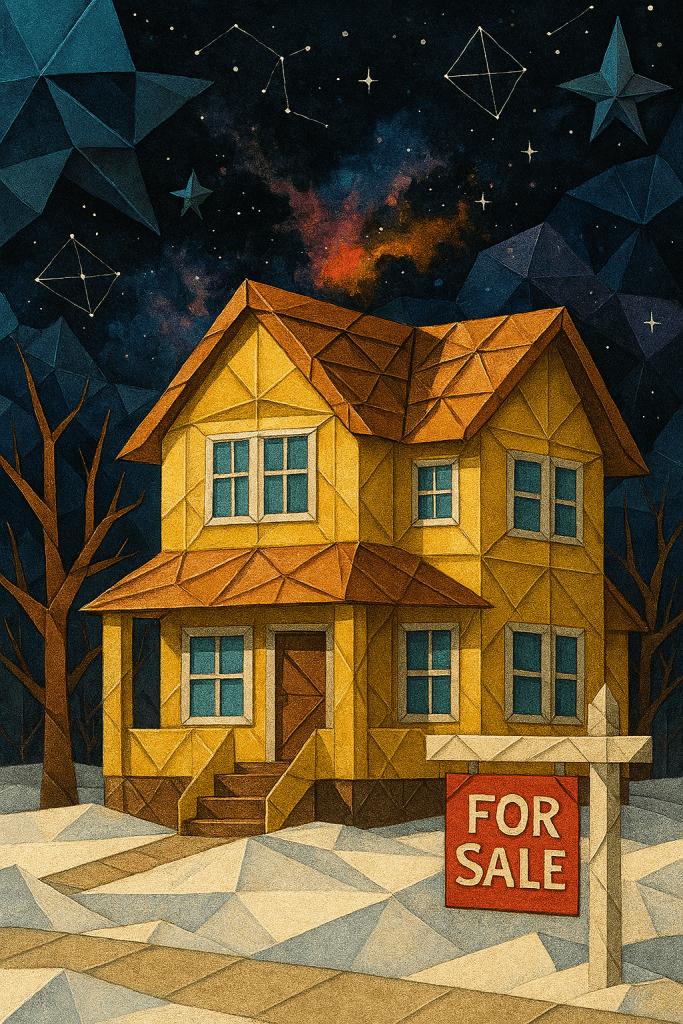
Our situation can be summed up by our recent hunt for a house. Months after the incident, my wife and I started looking for a home—a place to settle down, maybe start a family. It was supposed to be a hopeful, forward-looking moment. But when we saw housing prices in Toronto, I couldn’t help but think of how much easier it could have been if my mom hadn’t lost everything. We could have paid off most of a house upfront. Instead, we’ll spend the next 20 to 30 years paying it off.
We were house-hunting in the winter of 2024. The snow was bright and reflective, and every house we visited seemed to glow in the sunlight. The warmth inside each home was comforting against the cold. We saw some beautiful houses. But the better they were, the more expensive—and the more expensive, the more I thought about money. And there it was again: that push and pull in my head. On one hand, excitement for the future; on the other, resentment toward the past that made the future harder to reach. Optimism followed very closely by cynicism.
After walking through that minefield in my head every time a new house appealed to me, I actually felt relieved that it was just a thought experiment. The fact that I can imagine it calmly now feels like progress. At least I have the strength not to dive headfirst into another fight looking for reasons to hate. I can see the circumstances as abysmal and horrible in context but taking it at a level of acceptance helps. There truly is no benefit in gouging up old wounds. It serves no one.
Our situation isn’t perfect, but it’s better than before. We’re not burning through money just to pay off interest anymore. My wife and I are stable—lower middle to middle class now, maybe—but stable. Mom still has debt. Her refinanced mortgage is at a ridiculous rate, and she’s losing money each month on a condo she can’t even sell in this terrible market. That’s right—we have scars. But what can you really do?
Mom went from having a safety net and being able to help us, to working indefinitely just to stay afloat. But retirement belongs to the future. And after realizing that it helps no one to linger on the past or reopen old wounds, maybe it’s best not to reach too far ahead either. Both the past and the future have their ways of playing tricks on the mind. What we do have is now. So maybe the best we can do is take things as they come—one day, one step at a time. If we look closely enough, the present can be enough. The future will arrive when it’s ready.
Subscribe
Sign up to hear updates
 Memoirs of a tiger cub
Leave a comment