Happiness is best when it’s shared
Choosing Happiness
Chapter 18: Choosing Happiness
Things were now calm again. I had some time to think. No more CC. What to do now? I decided to take inventory of what musical things I still had in my life.
There were 4 senior music groups I did. A senior symphony orchestra and chamber orchestra for strings. Then there were two choir groups I was a part of. This was the Senior Choir Ensemble and the Madrigal Singers. These groups were fun. As I got more and more comfortable with the idea of being just a public school music student, I felt relaxed. The toxins in my body were starting to slowly seep out. Being in a public school as a public school music student was fun. It was what I thought music should be. Not a competition but a friendly group of buddies laughing and going on trips. Don’t get me wrong, we did compete. Most music programs in high schools across the country did some form of competition as a collective. But now I was competing with my classmates. We competed as a group. We did that together. I wasn’t sitting alone with no one to watch me in the audience like I had done in the recitals hosted by CC. I was on stage and even if no one from the audience was there for me, I was there for my other friends in the choirs and orchestras supporting them and at the very least, playing a role that felt important.
Looking back, I’m glad I got so much out of just being a part of something bigger. This was because we would often lose most competitions. Agincourt was a public school and unlike the movies or anime, that meant we had no money to do much of anything. We had public school instruments and not a lot of private lesson takers in our ranks. We were really only to competitions just to get more exposure about what music was like outside of our walls. Our teachers also said that getting outside of our school and seeing music by others was a good way to enrich our musical outlook and point of view as well. A point I thoroughly agree with.
There were a lot of competitions for high school music groups that we frequently attended and we would almost always lose to music schools or private schools. I remember hearing about the rankings for schools and always hearing about Earl Haig’s Claude Watson Program or the Cardinal Carter’s orchestra winning the competitions. Those were music schools. They had funding. Unlike our public school their school orchestra and bands were full of private-lesson-taking type-A competitors. I was even told by some that RCM level 10 was a requirement to enter some of those music schools at the top. That rumor didn’t even seem far-fetched either. These were amazing schools with amazing musicians. You can really hear it when you were in the audience during their performances. They were better coordinated and better trained. Furthermore, you could easily tell that their instruments were all personal ones, not the cheap public ones we were using.
My public school, funded by TDSB with a budget of a hamburger and a few quarters, had public school instruments. These were instruments that were shared by all the students in the school. If you wanted to practice at home, you had to sign out an instrument from the school, take it home, then bring it back the next day. What’s more is, the quality of the instruments were severely lacking. I had my own cello since I was taking private lessons. My cello wasn’t a spectacular cello by any means. I think it was around $1000 and was bought from a sketchy Chinese instrument maker who owned a small shop in the middle of a large industrial complex. It was good but you could tell it wasn’t expensive nor spectacular. However, in comparison to the ones at my school? It outshined the competition.
The public-school cellos that were shared with everyone? I’m sure they were bought wholesale for $1000 for 10. It was impractical to bring my own cello from home to school every day so I did use the public school ones for classes I attended. I remember the cello I used in classes. You could tell it wasn’t looked after very well. The telltale sign? It was greenish brown. Like it had been left alone in a damp room and grew moss. Another way to describe it was radioactive or maybe a bit sickly? Hard to say. I still liked it but sometimes, when we went on trips to competitions and I couldn’t bring my own cello with me, I would look up at the private school’s orchestra from the shadows and see the stark contrast between the instruments.
The orchestras that we competed against had instruments that glistened with the stage lights. You could tell that the instruments they were using were all privately owned ones and probably all handmade ones. No one was sharing instruments at their private school. Though this large disparity existed, and despite being out-classed, out-budgeted, and out-skilled, we still competed. Like I said, our competition was mainly for outlook and perspective. Our music teachers really just wanted us to experience what other orchestras of teenagers around our age could accomplish. If we didn’t win, that’s okay. It was still a nice field trip where we got to enjoy some decent music.
My music teachers in High School were Mrs. R and Mr. H. If you ever met them I think you can tell that they loved their job. They joked around a lot and we had tons of fun during school and rehearsals. They made me feel at home. As I mentioned previously, I sometimes still feel blessed to have been through the Canadian public school system having some of the best teachers I could have asked for. I would also later reflect back and find out that the times I spent in class with my music teachers were some of my most fondest memories decades down the line. No longer bound by CC, I started to realize what public school music programs gave me, it gave me the antidote to all the toxins CC was injecting me with. It was a cure to verbal abuse. It was the opposite. It was acceptance. In our public school orchestra, you couldn’t force people to practice with verbal abuse. You took them as they were. Some would try and do better in class and some would quit. By grade 12, only those who truly wanted to stay would be there…
and also some others who thought the class was an easy A.
Regardless, unlike the science courses I took, where I only remember a few things here and there and then forgot about it as soon as the exam was done, in music class we were there to make experiences happen. We were having fun. These were fond memories that I don’t have to spend effort to remember. Oh! And I’m not just referring to strings class here, in grade 12 I was also taking vocal class too. I was an average singer and just a normal student in vocal class. Even when I wasn’t a privately trained student of the instrument the class was about, I was still very happy to be there. Okay okay, I think I’ve said enough here. I liked my high school music program. You get the gist. With that being said, would you be surprised if I told you I almost didn’t want to take some of the classes in high school?
The thing with these music classes was this, they come with a co-commitment. If you took vocal class, you had to be in the choir. If you took music, you had to have at least one orchestra afterschool you were a part of. So while it was an easy and fun course, it did come with some free time commitment. As you’ll recall, free time was not a resource I had a lot of.
I can still remember being in grade 10 and debating whether or not I should join all the orchestras and choirs because I knew I was already incredibly busy with… well… everything we talked about in the last chapters. I was unsure if I was able to fit in all the things I wanted to do and still have enough time to study for my classes. This was a common dilemma in our school because as I mentioned, our school was full of Asians. All of whom wanted to go into STEM and needed highschool STEM courses. This meant that most of the Asians in school would do classical music and do it quite well but then be forced to quit as university rolled around because our parents forbid us to go into a field related to the arts.
Most of us knew that music was a high-school-only kind of deal. Since I was probably going to only do music in high school and then do STEM like every other Asian, a part of me was trying to invest in the future by allocating more free time to study for my science and math classes. This was the crux of the dilemma. Music courses, while easy, were a huge commitment sometimes.
Our music teachers at school were no strangers to this kind of conversation. They’ve been doing this a long time and have heard all stories from all of the Asians. They knew we were in a situation where STEM careers ahead of us and the high school music things were just a temporary thing. The conversation would always be something along the lines of:
“I’m not sure I’ll have time to do so much music in school.”
Or
“I’m not sure if these courses will benefit me in the future.”
Or
“I’m not sure if this will distract me from studying for my other courses.”
If I’m being honest, had I been trying for a much more competitive university program, these questions may have had more weight me much more. Luckily I was only going into Science, so the fact that it was easy meant I would be able to be a bit more flexible with my time. So this meant I didn’t take that much convincing to fill my schedule to the brim with music. All the convincing I needed was to hear “the speech” by Mr. H. This was a notorious conversation he would have with all the choir students at one point in their high school careers. It would go something like this.
He would walk into class one day and then get all our attention. Once he had it, he would then proceed to put down a coffee on our class piano. The coffee was usually just from a local shop nearby. Nothing special. But what he would then tell us was that someone who recently graduated came to him and gave him a coffee.
The reason for him getting a coffee was that it was a bet of sorts. The coffee would be from a student who decided not to take music or who had taken a reduced amount of music in their senior years in high school in favor of STEM commitments. This was a familiar scene. This student was usually someone who would’ve had an encounter with Mr. H where Mr. H would tell them to seriously consider what they may be losing out on if they give up on music in school. He wouldn’t need to say much more. Mr. H wasn’t one to guilt trip you, too much at least. That’s because anyone in this situation who came to him would already know the situation.
If you had gone to Mr. H with this question, you already knew that you wanted to do music in school. The conversation with him was really just you asking for him to validate your decision to leave music behind. Basically, when you went to Mr. H with the question, you were asking him to tell you that it was okay that you were choosing your future career choice, or your parent’s future career choice for you. You knew you wanted to do music. If you didn’t like music, you would’ve simply not taken the course and left without saying goodbye. No one would blame you if you didn’t do it and no one would go after your family. If you showed up and asked the question, it means that you knew what you wanted and were now asking for permission to not be happy.
Mr. H kind of understood what this meant. He was white and there was definitely something to be said about Western and Eastern philosophy. He was very liberal and wanted to support the happiness of the individual and the Asians really wanted to see our family and generations prosper. We had different values. That’s why I don’t think he tried so hard to take a stand. It was unfair for him to tell us what to do but he would give us a heart to heart saying that we should be aware of the fact that we are giving up something we love. He would then tell the student that should they ever find out that not doing music in high school was a mistake, they should come back and talk about it with him over some coffee. Boy did we see a lot of coffee cups.
I was only ever briefly in this scenario and luckily, I didn’t end up having to buy him any coffee. That’s right, I was able to save myself a whole $2. Nice! Also, I was able to experience those priceless high school moments and have friends that I’m happy to report are still with me today. Something that’s worth more than $2. What a steal.
This was also the right decision in the end I think. I remember two instances that validated this decision to do more music in high school. The first was that this decision would give me a core memory that I still cherish today. A very subjective and enriching experience. The second answer would not present itself to me until way later in life. You’re gonna have to skip a few chapters if you wanna know the answer to that one but I’ll give you a hint. It relates to something much more objective. If anything, this one fact would’ve made most people in my shoes choose music over any science courses in high school. I’ll tell it later since it deserves a chapter pretty much on its own.
Anyhow, I can tell you the core memory I was referring to right now. It was when our public high school beat the other music schools at a Kiwanis competition. That’s right, you read it right. Our school, running on a budget of a few potatoes, beat two music schools in the district. How was this possible? Choir! The Kiwanis competition had a special showcase competition for the ensembles who make it to the top of their respective fields. The finals was a three ensemble showdown between the best string ensemble, the best band ensemble and the best choir. While our string and band ensemble got completely wrecked by the music schools and their enormous budgets, our choir made it to the finals just fine.
In grade 12, our school went to Kiwanis again with all of our groups. Like I mentioned, the strings and band only got so far. However, our choir, to our surprise, got a very high score and even won the gold in our category. That’s when we got word of this invitational showdown. We were still unsure of how well we’d do. This was a weird competition afterall, how do you compare strings to band and to choir? Aside from classical music, they were all different styles of music.
We didn’t think too much about it, any recognition from a public school was big news and we were going to try hard for this no matter what circumstances. We had to show up and represent ourselves. Our entire choir and Mr. H himself was nervous because we were on the verge of winning a competition against music schools. A feat not common seen. I was even a bit nervous myself but the thing was, being nervous was much better when you were in a group setting. The anger and anxiety I felt from CC’s recitals didn’t hit me at all. I could look around the choir and see who I was going on stage with. I wasn’t there alone. I had friends there with me. We could depend on each other when we were anxious for ourselves and do well for their sakes as opposed to our own. I liked this setting. Performing as a group was fun. Even in a competition, I wasn’t feeling the toxic emotions flood through me. The fact that I was comfortable in a competition setting and being a part of a group in itself would have been enough for me to consider music worthwhile in high school. The feeling of being in a high stakes competition with fellow singers. That was a rush in all the right ways. Luckily, the story didn’t end there.
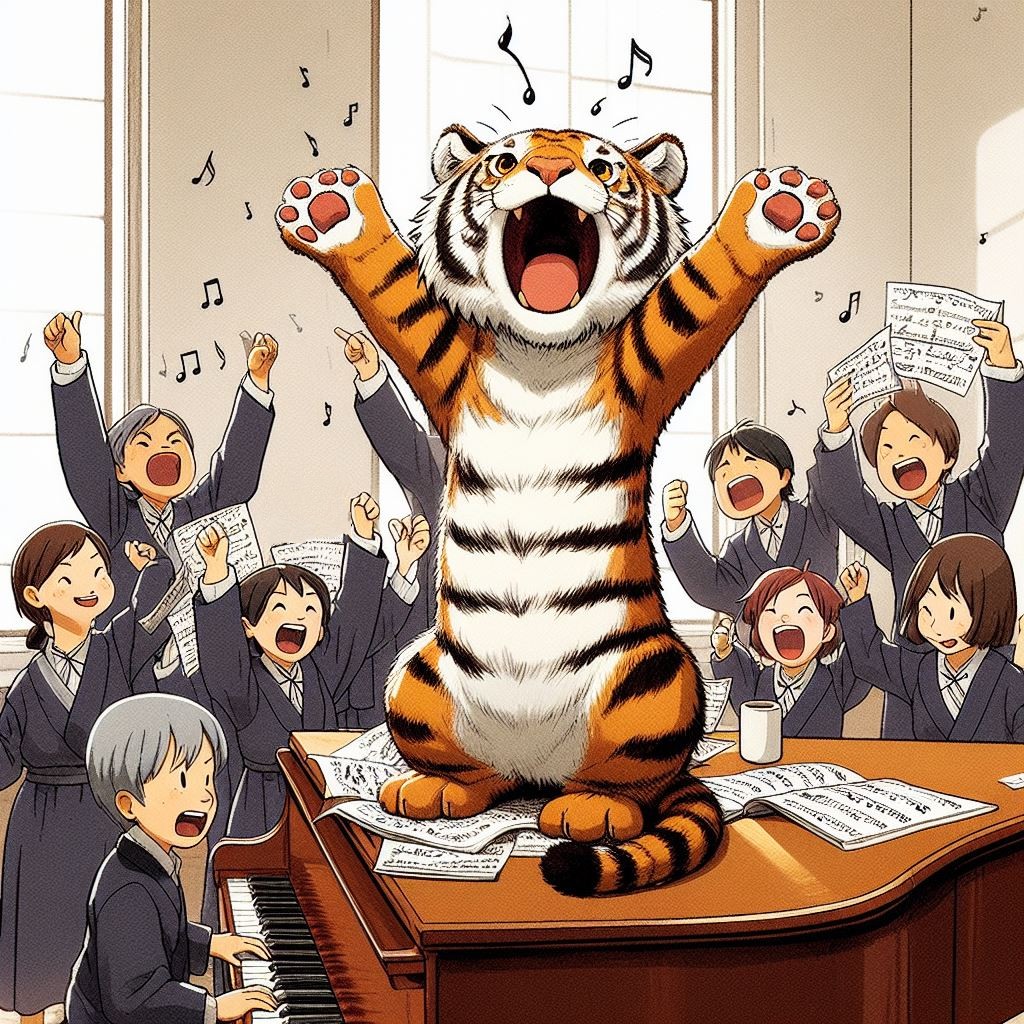
During one of his pep-talks, Mr. H told us that we had a small edge over the others. His reasoning was that the voices of humans can move people more than instruments. Something about a resonance in our souls from voices made by others was just visceral. You can’t get much closer to raw emotion with any other instrument. A second advantage was that our vices of low budgets for band and strings evaporated. You can’t simply buy a new set of more expensive vocal chords for the entire orchestra and give everyone vocal lessons to get a better choir. Not entirely at least. Unlike strings and bands where most musicians could train themselves to better the entire group, choir was more dependent on training as a group the entire time. You had to be good as a group, the individual and the individual mentality had to be thrown out. It was about balance. No more deathmarch to oblivion until practice becomes the only thing you know. This was about yin and yang and finding your part in a whole. While you could practice your part well individually, it was much more valuable to practice your part with others there with you in the choir setting. With that, the playing field had been leveled. We didn’t need to be individually the best. We simply had to be the best for each other. Our greatest hurdles were not of shining the most for ourselves but how to we can help each other in the group balance our whole. This was how we won.
I remember we sang Eric Whitaker’s Lux Aurumque. I remember the stage and most importantly, I remembered how happy we were when we found out the news. My only regret that day was being unable to see the other finalists’ performances. We were up against Cardinal Carter, a Christian private school and another music school from North York. I think it may have been Earl Haig’s Claude Watson Band. Both would have been the best of the best and definitely worthwhile to see. Regardless. I was just happy to be there. We were an underdog story that came to fruition. It was a fond memory. Along with the win, we got a cheque for a few thousand dollars and finally some funding came to our school. I realized at that point that I liked being in an ensemble way more than being a soloist. When you lose, its okay. When you win. You really do win. Winning is best done when it’s shared. I could say the same for what I think happiness is. I think in my entire life, even winning the silver medal didn’t feel this good.
Subscribe
Sign up to hear updates
 Memoirs of a tiger cub
Leave a comment